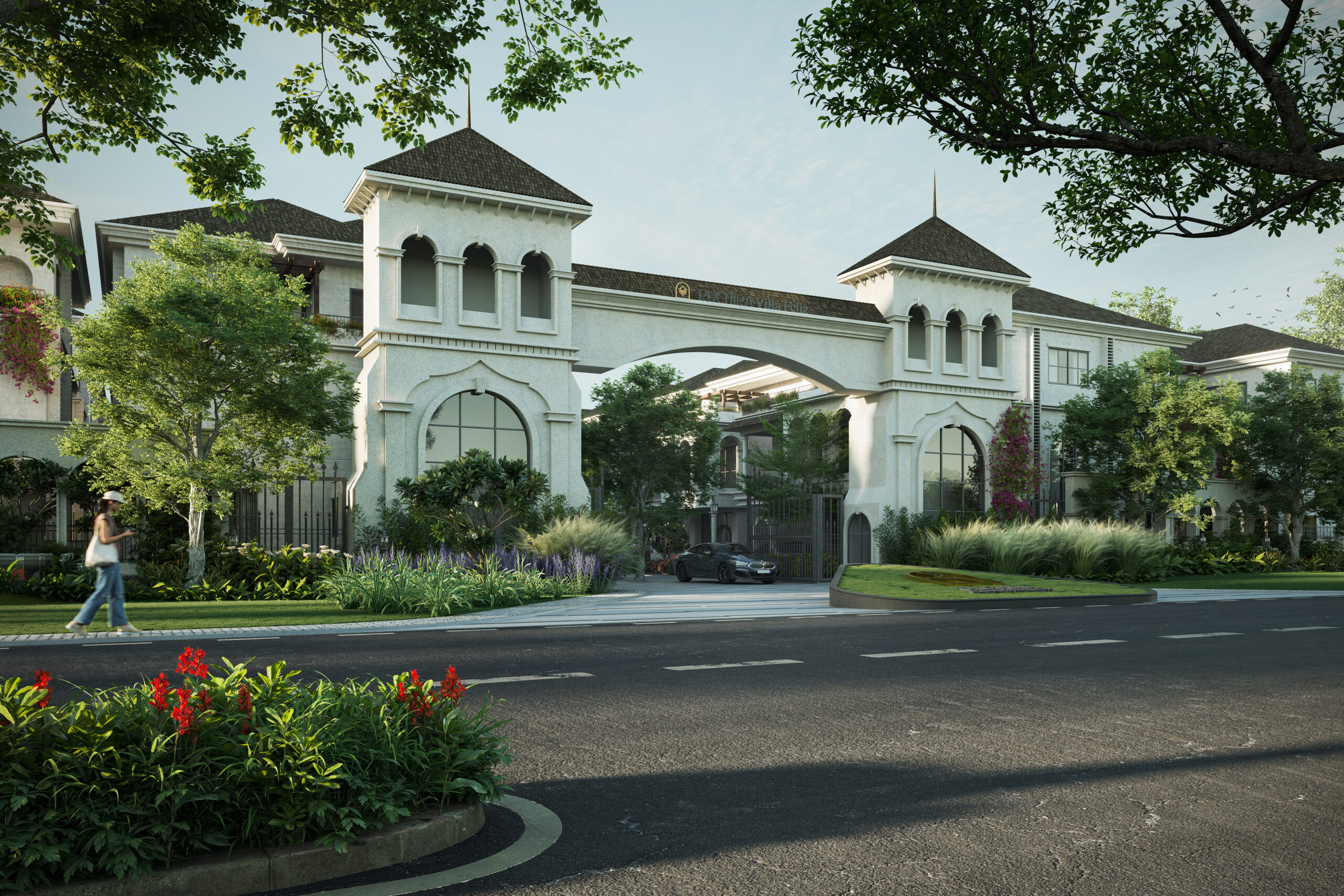
Villa Feliz — Luxury Villas on Sarjapur Road That Pay Back
What makes Villa Feliz different from other luxury villas on Sarjapur Road?
Villa Feliz is an IGBC Gold-certified community of 115 standalone 4 and 5 BHK villas on 10 acres just off Sarjapur Road, Bengaluru. A 200 kW rooftop solar grid generates about 24,000 kWh a month, a biomimicry sewage treatment plant recycles 100 KLD of water, and 117 recharge pits return roughly 175 million litres of rainwater to the ground every year. Together these cut the community’s running costs by an estimated ₹35.8 lakh a year and offset 245 tonnes of CO2 annually.
Most villa brochures on Sarjapur Road agree on one thing: the price per square foot. Almost none of them tell you what the villa will cost you in year three, year eight, or year fifteen.
That silence is where buyers get it wrong. A villa is not a flat. There is no society pooling a thousand electricity bills, no shared borewell quietly absorbing a dry summer. Every litre and every unit is yours, and on a 4,000 sq ft home with a garden, a home office and two air-conditioned floors, those numbers add up faster than most families expect.
So this post does something the usual villa write-up skips. It walks through what Villa Feliz was engineered to do about the bills, the water and the air, with actual figures from the project, and it tells you plainly who this community is built for and who should probably look elsewhere.
Stay for the water section. That is the one that decides whether a Sarjapur Road villa is a good idea at all.
The ₹35 lakh-a-year arithmetic
Villa Feliz saves its residents an estimated ₹35.8 lakh every year before anyone has adjusted a thermostat. The figure comes from two systems, and both are already specified into the project rather than promised as a future upgrade.
Solar first. A 200 kW grid-tied solar installation across villa roofs and common areas produces around 24,000 kWh a month. At current BESCOM tariffs that is roughly ₹23.04 lakh a year the community does not pay the grid, and about 245 tonnes of CO2 that never leaves a chimney. Spread across 115 homes, it is the difference between a villa that runs two ACs guiltily and one that runs them on sunlight.
Then the water you never see. Every community treats its sewage; Villa Feliz treats it with ECOSTP, a biomimicry system that copies the way a cow’s digestive tract breaks down organic matter. No aerators, no chemical dosing, no motor running all night. A 100 KLD plant on this design saves about 56,365 kWh a year in pumping and aeration energy, which is another ₹12.8 lakh off the community’s annual bill. The treated water goes back into flushing, landscaping and the car wash bays.
| System | Annual saving | What it replaces |
|---|---|---|
| 200 kW solar grid (24,000 kWh/month) | ₹23.04 lakh | Grid electricity for villas and common areas |
| ECOSTP biomimicry STP (100 KLD) | ₹12.8 lakh | Energy-hungry conventional STP |
| Combined | ₹35.84 lakh | 245 tonnes CO2 offset per year |
These are community-level numbers, so the honest way to read them is as lower maintenance charges and a smaller monthly bill for each home, not a cheque in the post. But over a 15-year hold, the arithmetic quietly adds up to the price of a second car park, every year, for doing nothing.
75 million litres: the Sarjapur question nobody asks at the site visit
Sarjapur Road has no Cauvery pipeline reaching most of its villa belt. Homes here run on borewells, and borewells run on whatever the ground has left. Ask any family that lived through the 2024 summer, when tanker prices in south-east Bengaluru tripled in a month, and they will tell you the real luxury on this corridor is not the Italian marble. It is a tap that works in April.
Villa Feliz was designed around that fact rather than around it. The site has 117 recharge pits, one for every villa, plus 1,250 metres of bioswales and percolation trenches threading through the landscape. Rain that falls on the 10 acres is slowed, filtered and pushed back into the aquifer instead of running off into a storm drain. The engineering estimate is about 175 million litres recharged every year, which is more water than the community draws out.
That is the sentence to remember. A community that puts more into the ground than it pulls out is not just “rainwater harvesting compliant”. It is insuring its own borewells.
The rest of the water story is smaller but it compounds: the ECOSTP’s treated output covers flushing and the gardens, so fresh water is reserved for kitchens and bathrooms; drip irrigation replaces sprinklers; low-flow taps and dual-flush toilets are standard, not an upgrade. None of this is visible on a site visit. All of it shows up on the day the tanker does not need to come.
What IGBC Gold actually changes inside your home
IGBC Gold is the second-highest rating the Indian Green Building Council awards, and most buyers file it under “nice to have”. It is worth understanding what the certificate forces a developer to do, because the effects are things you live with every day.
The air. Low-VOC paints and green-certified materials, including earthen bricks, mean the house does not off-gas solvents for its first two years. Families with young children or anyone with a sensitive chest notice this within the first week.
The temperature. System aluminium windows with high-performance glass are the single biggest reason a villa stays cool in a Bengaluru May without the AC running flat out. Combine that with villas that share no walls and have cross-ventilation on every floor, and the solar grid is powering a home that needs less power to begin with.
The waste. An on-site organic waste converter turns kitchen waste into compost for the central park and the butterfly garden. The bins that leave the community are a fraction of what a conventional layout sends to Bellahalli.
The car. Every villa has its own EV charging point. That sounds minor in 2026. By the time your second car is electric, it is the difference between a villa with a cable running out of a window and one that was built for it.
And there is a financial footnote most buyers miss: several Indian lenders now offer green home loan products with a small interest concession for IGBC-rated homes. On a villa-sized loan, even a quarter-point matters. Ask your bank, and ask our team which lenders have already approved the project.
Standalone means standalone: the 10-acre layout
A surprising number of “villas” on Sarjapur Road are row houses with a marketing budget. Two shared walls, a 30-foot frontage and a neighbour’s generator under your bedroom window.
Villa Feliz is 115 homes on 10 acres, every one of them a fully detached 4 or 5 BHK of up to 4,000-plus sq ft, with no shared walls and light on all four sides. The Spanish-inspired architecture is not a façade treatment; the courtyards, deep verandahs and terracotta tones exist because they shade the walls and pull air through the house, which is what keeps a south-facing villa liveable without the AC doing all the work.
The low density is also why the amenities feel like yours rather than a hotel’s. The 13,000 sq ft G+2 clubhouse holds a pool, a mini theatre, a co-working lounge for the days you skip the Outer Ring Road, a library corner and a multipurpose hall. Outside, the central park runs to a mini-golf green, a butterfly garden, a maze garden, a treehouse, an amphitheatre and a koi pond, with a cricket practice pitch, basketball and beach volleyball courts for the teenagers. Across 115 families, none of it is ever crowded.
Inside each villa: an 8-foot teak-framed main door, Italian marble through the ground floor living and dining, laminated wooden flooring in the bedrooms, home UPS backup, and a lift-ready core so the house still works when the stairs stop being fun.
Who Villa Feliz is for, and who it is not for
It is for families who intend to live here for a decade or more. The sustainability systems pay back over years, not months, and the layout rewards people who use the clubhouse on a Tuesday rather than show it to guests on a Sunday. Wipro’s campus is 5.5 km away, RGA Tech Park 6.5 km, Greenwood High and Oakridge about 7.5 km, STRR 2.5 km, Karmelaram station 9 km. The daily geometry works.
It is for buyers who have done the Sarjapur water homework and want a community that has done it too.
It is probably not for the pure flipper. Villa Feliz is a low-churn community by design; the appreciation story on this corridor is real (we covered it in Sarjapur Road, Decoded), but the value here compounds slowly through lower running costs and a community that holds together, not through a quick resale.
And it is not for anyone who wants to be on the main road. The site sits just off Sarjapur Road on purpose. You trade a few minutes of access road for a community where you can hear birds in the butterfly garden, and that trade is the wholeStandalone means standalone: the 10-acre layout point.
Frequently asked questions
Is Villa Feliz IGBC certified?
Yes. Villa Feliz is certified IGBC Gold by the Indian Green Building Council, covering energy, water, materials and indoor air quality.
How much electricity does the solar at Villa Feliz generate?
The 200 kW grid-tied solar installation generates about 24,000 kWh a month, offsetting roughly ₹23 lakh a year in grid electricity and 245 tonnes of CO2.
Does Villa Feliz have a water problem like other Sarjapur Road projects?
The project is built on borewells, like most of the corridor, but 117 recharge pits and 1,250 m of bioswales recharge an estimated 175 million litres a year, and treated STP water covers flushing and landscaping. The design puts more water into the ground than the community draws.
What is ECOSTP?
A biomimicry sewage treatment plant that digests waste the way a cow’s stomach does, without motors, aerators or chemicals. At Villa Feliz the 100 KLD plant saves about 56,365 kWh and ₹12.8 lakh a year.
What villa sizes are available at Villa Feliz?
Standalone 4 and 5 BHK villas up to 4,000-plus sq ft on a 10-acre low-density layout with 115 homes and no shared walls.
Where exactly is Villa Feliz?
Just off Sarjapur Road in south-east Bengaluru, about 5.5 km from the Wipro campus, 2.5 km from STRR and 9 km from Karmelaram railway station.
Is Villa Feliz RERA registered?
Yes. RERA no. PRM/KA/RERA/1251/308/PR/280325/007634.