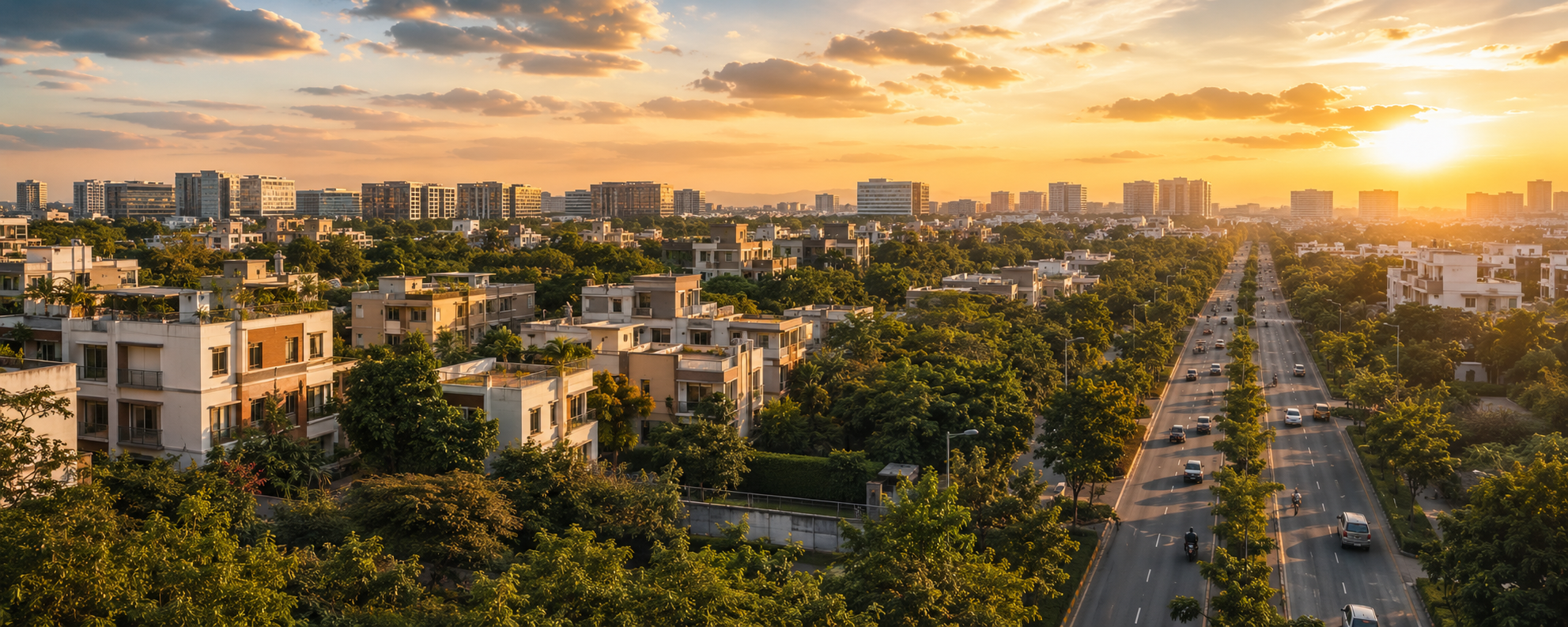
Sarjapur Road, Decoded: What’s Really Driving Demand on the South-East Corridor
“Sarjapur Road is the next big thing.” You’ve heard it. So have I, roughly a hundred times this year. The phrase has been repeated so often that it has quietly stopped meaning anything. So let’s not repeat it. Let’s take the corridor apart instead and look at what is genuinely driving the demand, one honest driver at a time, including the part most brochures would rather you skipped.
A quick disclosure: we build here, so this is not a neutral view. But every fact below is a matter of public record, and worth knowing whether you buy from us or from anyone else.
It Starts With the Map
Everything about Sarjapur Road begins with where it sits. The corridor runs from the Outer Ring Road near Marathahalli down to Sarjapur town, and in doing so it lands within reach of three of Bengaluru’s biggest job engines at once: the ORR tech belt, Whitefield, and Electronic City. Work in any of the three, and your commute is usually twenty to forty minutes. Most corridors in this city live and die by a single employment hub. This one leans on three. That redundancy is quietly the most valuable thing about it, because demand built on three foundations does not wobble when one of them has a bad year.
Driver One: The Jobs Are Next Door
Housing follows jobs. Always. And Sarjapur Road is ringed by some of the densest office space in Asia. Embassy TechVillage, among the largest office parks in the country, anchors the ORR end. The Wipro campus sits at Doddakannelli, with a larger Wipro development planned toward Kodathi. Add RGA Tech Park, RMZ, a cluster of SEZs, and fresh activity near Dommasandra, and you have a workforce that grows every quarter. Further out, the proposed SWIFT City hub could become an employment engine in its own right. Every one of those desks eventually turns into a housing decision, and most of those decisions go looking for a home within a short drive.
Driver Two: Infrastructure That’s Arriving, Not Just Announced
Here is where I would ask you to slow down, because corridor marketing loves to blur the line between what is running and what is merely promised. What is genuinely underway is what matters. The headline is the Namma Metro Phase 3A Red Line, planned to connect Hebbal to Sarjapur across a long run of new stations, and history shows that metro-anchored pockets tend to appreciate faster once the trains actually run. Around it sit the Peripheral Ring Road, the Satellite Town Ring Road, and steady widening of the main Sarjapur artery. But hold onto that word: arriving. A metro line under construction is a strong signal. It is not the same as a station you can walk to tomorrow morning.
Driver Three: Built for Families, Not Just Investors
Much of Sarjapur Road’s demand is driven, quietly, by parents. Few corridors in the city pack in as many international schools, Greenwood High, Oakridge, Orchid International, GIIS, and the healthcare and retail around them keep maturing. That is exactly why so much new supply here arrives as self-contained townships rather than lone towers. People are not buying an address. They are buying a daily life in which home, school and work all sit inside a short radius. On this corridor, that life is genuinely achievable.
The Part Most Brochures Skip
Now the honest bit, because a corridor worth buying into is a corridor worth understanding in full. Water is the real caveat. Large stretches of the south-east still run on borewells, and as construction and density climb, groundwater is under real strain. Before buying anywhere here, ask pointed questions about a project’s water plan: its rainwater harvesting, its recycling, its long-term supply. Over the next decade, water security will shape both liveability and resale value as much as location will. Peak-hour traffic on the main road is the second caveat. And in the plotted-land pockets, legal due diligence is not optional. None of this dents the corridor’s case. It simply means buying with your eyes open, which is the only way worth buying.
Reading the Micro-Markets
“Sarjapur Road” is really a string of distinct neighbourhoods, each with its own character. Kaikondrahalli and Kasavanahalli, just off the ORR, are the mature, premium pockets with the deepest social infrastructure. Doddakannelli lives in the shadow of Wipro. Carmelaram and Kodathi offer more room to breathe and sit closest to the metro and suburban-rail story. Gunjur is the accessible entry point, with a rental market that rarely sits still. Dommasandra and the Attibele stretch are the frontier, still priced below the inner cores. As a rough map, corridor prices run from about ₹7,200 to ₹12,000 per square foot depending on the pocket, climbing higher in the metro-anchored Kodathi belt, and ANAROCK has pegged three-year appreciation near 79%. Where you buy should follow why you are buying.
Where Ruchira Sits on This Corridor
This is the stretch we chose for Ruchira Villa Feliz, our community of standalone 4 and 5 BHK villas off Sarjapur Road. We chose it for every reason above: the three-way access, the depth of employment, the family-first social fabric. And that water caveat I raised? For us it is not a footnote, it is central to how we build. Villa Feliz is designed to be water-conscious from the ground up, because on this corridor, the homes that still hold their value in a decade will be the ones that took water seriously on day one.
So if Sarjapur Road is on your list this year, decode it the way you would approach any big decision. Follow the jobs. Separate real infrastructure from promised infrastructure. And ask every developer the same blunt question: what happens when the borewell runs low? The corridor rewards the buyers who look past the headline.
Rooted in you.
Frequently Asked Questions
Why is Sarjapur Road in such high demand?
Its location gives it twenty-to-forty-minute access to three major employment zones at once, the ORR tech belt, Whitefield and Electronic City, backed by dense IT office space, a deep set of international schools, and a strong infrastructure pipeline. That mix keeps both end-user and rental demand consistently high.
What is the average property price on Sarjapur Road in 2026?
Apartment prices broadly run from about ₹7,200 to ₹12,000 per square foot depending on the pocket and developer, climbing higher in the premium metro-anchored Kodathi belt. ANAROCK has estimated corridor appreciation of close to 79% over three years.
What infrastructure is driving Sarjapur Road growth?
The main catalysts are the Namma Metro Phase 3A Red Line from Hebbal to Sarjapur, the Peripheral Ring Road, the Satellite Town Ring Road, and ongoing widening of the main Sarjapur artery, all of which should compress commute times across the south-east.
Is Sarjapur Road better than Whitefield?
They suit different buyers. Whitefield is more mature, with an operational metro and established infrastructure today, while Sarjapur Road offers lower entry prices and more future growth headroom as its metro and ring-road projects arrive. It comes down to your timeline.
What should I watch out for when buying on Sarjapur Road?
Water security is the big one, as many pockets still depend on borewells, so check a project’s rainwater harvesting and long-term water strategy. Also factor in peak-hour traffic, insist on legal due diligence for plotted land, and always verify the project on the Karnataka RERA portal.